
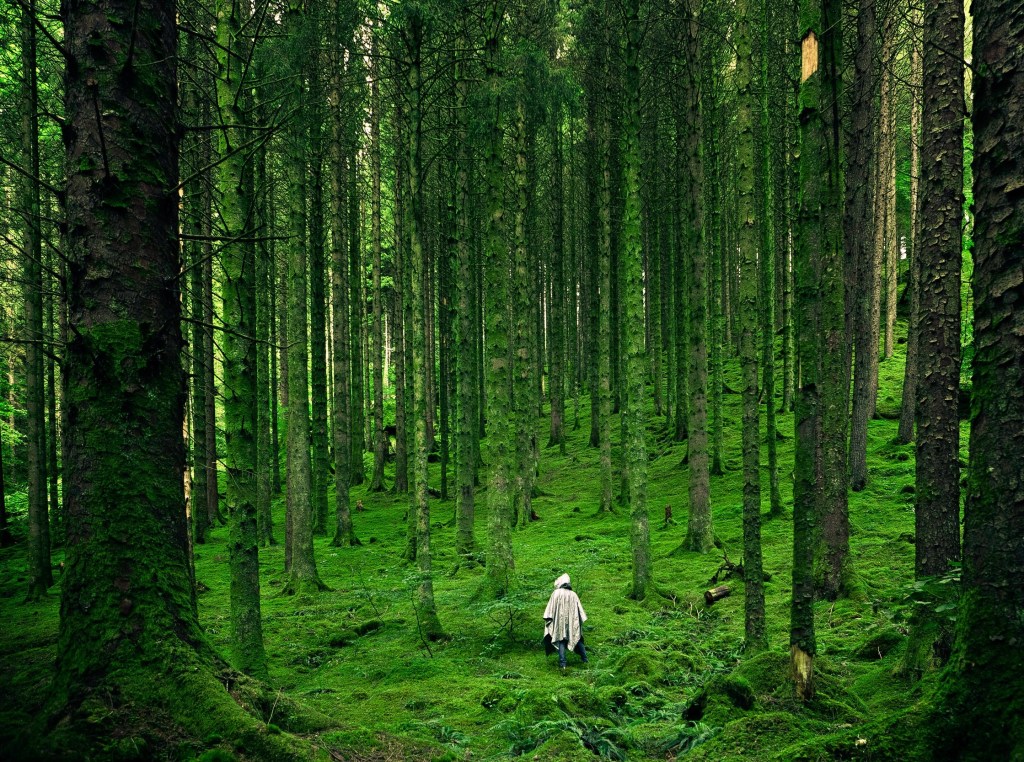
Have you ever heard this old adage?
“You can’t see the forest for the trees.”
It is meant for people whom–being so bogged down with the tedium of a detail– fail to see the overall issue. The phrase was first recorded in John Heywood’s proverb collection in 15461. But people, as a whole, don’t change. This idiom may be one of the more popular ways to describe the notion, but it certainly wasn’t the first time a person has suffered from blind spots, nor should we expect to see an end to them any time soon.
…For we are human.
I think that’s where we run into trouble. We see a tree, but do not stop to consider the forest. So, what if this idiom was applied to our world-views, our beliefs, the things we hold as true and good? What if this idiom was applied to us as an individual and where we fit within society? I don’t think it’s overly important to know the ins-and-outs of the forest. Sometimes it’s simply enough to know that the tree plays a smaller part in a larger whole.
In a forest, no tree truly stands alone. They are connected in the ecology; by the animals that hunt, breed, and roost there; by the winds which spread their pollen, seeds and spores; by the roots and mycelium, woven within the soil, which absorb nutrients. The forest is a series of connections.
Likewise, world-views are formed from individual data points. What seems as an individual concept or statement is actually dependent upon the integrity of the whole.
People like to give hot-takes on issues without considering the bigger picture…without considering its connectivity…without considering its reflection of the whole.
A Reflection of the Whole
If you study one tree in one forest, shouldn’t it reflect the state of the forest? When the leaves begin to turn brown on a tree, it announces the approach of autumn. The leaves green-up and it blossoms in the spring. When blight and pests take hold in a tree, will it soon spread to the rest?
The ecology and climate of the forest provides certain growing conditions. When conditions are met, this could help or hinder certain types of trees. Eventually, this is what shapes the forest. This is why, around the globe, forests can be found which exhibit a majority of specific species. There are the the redwood forests of California, the silver birch forests of Scotland, and the pines, spruces, and larches of the Taiga Forest, to name a few.


When this concept is applied to world-views, you achieve intellectual integrity. The world-view is upheld by each individual pillar, each detail, each argument… When there is one that does not agree or reflect the core belief, it needs to be studied. Is it damaged? Does it carry an illness? Is it an invasive species? Is it a threat to the wellbeing of the forest?
Life and Death
Just as there are those who see the tree, but do not consider the forest; there are also those who see the forest and do not consider the tree. It is important to consider if the whole is good or not. And what is a whole but the sum of its parts? Are the trees life giving or death dealing?
There is a class of plants known as a clonal colony2. In these “forests”, each individual plant has genetic material which is identical to its neighbor. In fact, what appears to be a separate organism above ground is actually connected underground by their roots. Essentially, the forest is made of the exact same tree. Each tree truly reflects the nature of the forest (its principles, if you will). Since the trees are genetically identical, the forest is considered a single living organism.
The largest living organisms are the Pando Forest in Utah and the Honey Mushroom in Oregon. The Pando Forest is made of replicating trees. The goal of the forest is to grow and produce life. With each tree comes a new respite in the woods for some creature. The Honey Mushroom, on the other hand, is sustained on decomposition. It needs to feed on other trees in order to live. Its life results in death for others.


Both of these organisms are highlighted in Hit Record TV’s first episode3. In it, Joseph Gordon-Levitt poses a question. If humans (sharing 99.9% of the same DNA) were considered a connected organism, then which organism are we more like? Are we, “…the life-sucking mushroom kind or the harmonious forest kind?”
One should ask that of the beliefs he or she holds as “good”—and maybe they are good. All the more reason to be aware of their principles and the precepts that support them.
The Forest: A Measure for the Tree
The parts are intermingled with the whole. In the instance of the Pando Forest, the trees are reflecting the core principle: the forest is life giving. Each tree is life giving. The trees fulfill the truth of the forest simply based on the existence of the truth. They are organisms with complete integrity.

Some threats to the health of forests are poor soil conditions, pests, and diseases. The tree can only thrive to a certain level—that which the forest will allow. If the forest is the measure of a tree, then there is a limit to the health of the tree.
In world-views, there are abusive and negligent behaviors or ideas. A man will behave in accordance with what his world-view will allow…provided he adheres to the intellectual integrity of the world-view. As Victor Frankl states in Man’s Search for Meaning, “An abnormal reaction to an abnormal situation is normal behavior.”4
If a precept in their world-view is poor, they will behave poorly. If a precept in their world-view is good, but the person ignores it, they will behave poorly. If, overtime, enough people ignore a good precept, it is not unlike a tree touched with blight which will consume the rest of the community. The forest is the measure for the tree, but one cannot thrive without the other.
If the forest is the measure of a tree, then there is a limit to the health of the tree.
The Blog
Why is this site called The Forest in The Trees?
A whole can be defined by its parts. Without trees there would be no forest. I get lost in the trees. I love to read, research, and study. I love to consume art and stories. Sometimes I forget why I am doing it. What is the meaning of it all? What ultimate truth are they upholding?
In The Call of Cthulhu, H.P. Lovecraft wrote:
“The most merciful thing in the world, I think, is the inability of the human mind to correlate all its contents… some day the piecing together of dissociated knowledge will open up such terrifying vistas of reality, and of our frightful position therein, that we shall either go mad from the revelation or flee from the light into the peace and safety of a new Dark Age.”5
This is basically the choice that Morpheus offered Neo in The Matrix in the form of a blue pill or a red pill…to wake-up to reality.6
I tend to disagree with Lovecraft’s quote. I would find it a blessing. To be able to look at a tree and understand the truth of the forest sounds like bliss. This blog is a journey in that direction.
Each individual tree holds a precept of the forest. If this is the case, then we need to know the principle the tree is supporting. The forest would be growing in a general direction. We need to know if that direction is good or bad.
This blog is a journey into the wilderness. An exploration of the trees…philosophy, theology, mythology, (other -ologies), books, movies, plays, current events, and the list goes on. There is truth in nature and I believe the echo of those truths travel far beyond the tree line of a literal forest.
Come with me as I explore The Forest in the Trees.
References
- Sharman, Julian. The Proverbs of John Heywood. Being the “Proverbes” of that author printed 1546. London: George Bell and Sons, 1874. Page 163.
- “Clonal Colony.” Wikipedia, 4 June 2021, en.wikipedia.org/wiki/Clonal_colony. Accessed 9 Sept. 2021.
- “Episode #1 // HITRECORD on TV.” http://www.youtube.com, youtu.be/Fl_wdODKGtM?t=522. Accessed 9 Sept. 2021.
- Frankl, Viktor E. “Man’s Search for Meaning.” (Paperback) (Kindle)
- Lovecraft, H.P. “The Call of Cthulhu.” (Leather Bound) (Kindle Edition)
- “The Matrix.” (The Complete Matrix Trilogy)


 Nicholas B. Spurrier
Leave a comment